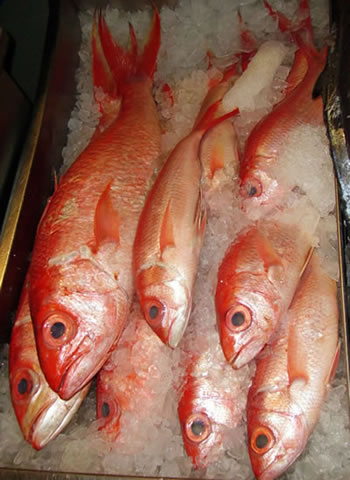
I HAD ALL TYPES OF FISH FROM POMFRET TO ROHU TO KATLA TO RAAWAS , YET THRER IS SO MUCH MORETO EAT AND MORE TO LEARN , YET I AM LOOKING FOR A BETTER AND BETTER APPETIZER THIS TIME I HOPE IT WILL BE RED SNAPPER ...SOUNDS YUMMY.. HA HA
 I HAD ALL TYPES OF FISH FROM POMFRET TO ROHU TO KATLA TO RAAWAS , YET THRER IS SO MUCH MORETO EAT AND MORE TO LEARN , YET I AM LOOKING FOR A BETTER AND BETTER APPETIZER THIS TIME I HOPE IT WILL BE RED SNAPPER ...SOUNDS YUMMY.. HA HA

 SALMON(RAWAS)
 COD
COD
 SALMON

Lobster with Ginger and Onion
Ingredients:
Approx. 900g or 2lbs, or use frozen lobster tails)
4 stalks of green onion
Several slices of ginger
Seasoning:
2/3 tsp salt
1/3 tsp sugar
dash of sesame oil and ground pepper
2/3 cup chicken stock
Directions:
Kill lobster by stabbing a chopstick deep into its mouth. Wash and chop into pieces. Drip dry and mix with 1 Tbsp of corn starch.
Deep fry at high heat for a while; dish up.
Sauté green onion and ginger with 2 Tbsp of oil at high heat. Add lobster pieces and stir fry.
dd seasoning. Bring to a boil at high heat, cover for 1/2 minute. Thicken with cornstarch mixture; ready to serve
Stir-Fry Prawn Fritter with Soya Sauce
Ingredients:
500 gm prawns, 10x
1 tsp chopped garlic
25 gm ginger, minced
1 sprig spring onion, diced
¼ tsp salt
Seasoning:
3 tsp light soy sauce
1 tsp oyster sauce
3 tsp water
½ tsp Shaoxing wine
¼ tsp dark soya sauce
Thickening:
½ tsp cornflour solution
Directions:
Trim off legs and devein, clean and pat prawns dry. Chop garlic, ginger and spring onion for later use.
Heat up oil, add in prawn to deep fry until golden brown. Remove and drain well for later use.
Heat up 2 tbsp of oil, stir fry chopped garlic and ginger.
Return prawns and season.
Dish up and sprinkle spring onion on top. Serve.


Chop suey
From Wikipedia, the free encyclopedia
Jump to: navigation, search
For other uses, see Chop suey (disambiguation).
Chop suey
Traditional Chinese:
雜碎
Simplified Chinese:
杂碎
Hanyu Pinyin:
zá suì
Cantonese Jyutping:
zaap6 seoi3
Literal meaning:
mixed pieces
[show]Transliterations
Mandarin
- Hanyu Pinyin:
zá suì
Cantonese
- Jyutping:
zaap6 seoi3
- Yale Romanization:
jaāhp seui
Chop suey (Chinese zá suì, "mixed pieces") is an American-Chinese dish consisting of meats (often chicken, fish, beef, shrimp or pork), cooked quickly with vegetables such as bean sprouts, cabbage, and celery and bound in a starch-thickened sauce. It is typically served with rice but can become the Chinese-American form of chow mein with the addition of stir-fried noodles.
Chop suey is part of American Chinese cuisine, Canadian Chinese cuisine, and Indian Chinese cuisine.
Chop suey is widely believed to have been invented in America by Chinese immigrants, but in fact comes from Taishan, a district of Guangdong Province which was the home of most of the early Chinese immigrants; the Hong Kong doctor Li Shu-fan reported that he knew it in Taishan in the 1890s.[1]
Chop suey first appears in an American publication in 1898, described as "A Hash of Pork, with Celery, Onions, Bean Sprouts, etc."[2]
Despite its Taishan background, there are various colorful stories about its origin, which Davidson (1999) characterizes as "culinary mythology": Some say it was invented by Chinese immigrant cooks working on the United States Transcontinental railway in the 19th century. Another story is that it was invented during Qing Dynasty premier Li Hongzhang's visit to the United States in 1896 by his chef, who tried to create a dish suitable for both Chinese and American palates:[3] when reporters asked what food the premier was eating, his cook found it difficult to explain the dishes, and replied "mixed pieces";[4] But this is also untrue.[5]
In his book The Gangs of New York (1927), Herbert Asbury attributes the Americanized version of the term to a San Francisco dishwasher, calling it a bastardized version of the Cantonese phrase tsap sui, meaning "odds and ends", "miscellaneous pieces", or more simply "hash".
Outside of Taishan, the name "chop suey" or "shap sui in Cantonese,[3] and "za sui", when used in Mandarin, has the somewhat different meaning of cooked animal offal or entrails. For example, in the classic novel Journey to the West (circa 1590), Sun Wukong tells a lion-monster in chapter 75: "When I passed through Guangzhou (Canton), I bought a pot for cooking za sui - so I'll savour your liver, entrails, and lungs." This may be the same as the "Chop Suey Kiang" found in 1898 New York.[2]
During his exile in the United States, Liang Qichao, a Guangdong native, wrote in 1903 that there existed in the United States a food item called chop suey which was popularly served by Chinese restaurateurs, but which local Chinese people did not eat.[6] The term "za sui" (杂碎) is found in newer Chinese-English dictionaries with both meanings listed - cooked entrails, and chop suey in the Western sense.
This dual meaning has meant that some Chinese restaurants in English-speaking countries label mixed entrails as "chop suey" on their English menus.
One of the last remaining vertical chop suey neon signs in the world is located in Los Angeles, California, at the Far East Chop Suey restaurant in Little Tokyo.
Varieties
Chop suey may be prepared in a variety of styles, such as chicken, beef, pork, king prawn, plain and special. Plain, or vegetable chop suey, is often one of the few traditional Chinese American take-out dishes offered without meat at many restaurants.